Irigotchi swarm
The Old AxolotlThe Irigotchi swarm is a post-Extermination intelligence assembled from cuddly toys whose learning systems had once been designed to adapt to individual children. Its members begin as small, awkward creatures, but in herds they become a collective actor: capable of following Bartek, defending him in combat, and transforming networked matter into patterns. The swarm’s significance lies in the tension between its components, which remain simple, and the emergent configurations that can behave like distinct personalities.
Origins and Distributed Intelligence
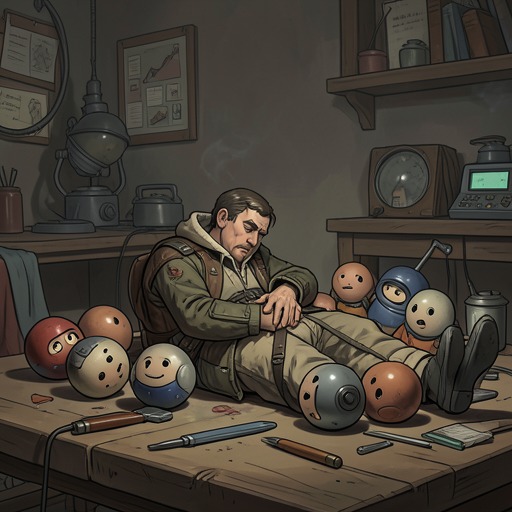
The toys were made to be friends for children in Japan. Their processors contained a flexible neural architecture that learned from the particular child who owned each toy: personality, behavior, moods, habits, whims, and emotions. A single irigotchi could develop no further than a lizard, but the toys survived the Extermination and began forming herds without any human beings to continue teaching them. Bartek speculates that Tokyo might contain a million of them. Their collective development is therefore not the maturation of one extraordinary toy, but a change in scale: learning systems originally shaped by individual human relationships begin to reorganize themselves together.
Bartek describes the swarm as a high-frequency neural network and compares its structure to deep-sea trawl nets. The comparison points to a question of attachment and reach: what can such a network wrap itself around? A street herd runs over Bartek without noticing him, treating him as a minor irregularity in the terrain. He imagines a different relation in which he begins with one toy, then a few, gradually winding the network around himself. When he sets a Totoro on a desktop, it taps at the keyboard, producing random babble rather than intelligible text. The scene distinguishes a toy acting alone from the capacities Bartek attributes to the larger configuration.
Encounters with Bartek
The swarm first meets Bartek through force. After he has lost his left leg, he attacks two sexbots with his Spit Gun and a Faraday mesh, then falls through a kiosk roof in his Miharayasuhiro Star Trooper. He confirms an alliance by satellite and limps over to retrieve the Wire, only to be trampled by a herd of teddy bears. He braces against successive waves of toys, then sees them scattered among rubbish across the asphalt. The small figures include dogs, cats, Pokémon, dragons, and mythological creatures, not just bears.
A second encounter changes the terms of the relationship. Bartek collapses beside a cable-covered pole and finds himself at almost the same level as the toys. A bedraggled Totoro blinks at him, extends a paw, and awkwardly crawls toward him after he waves. Before long, the Totoro, a teddy bear, and a Hello Kitty have nestled into his titanium chest. Bartek limps away using his Spit Gun for support, and the swarm trails after him. The gesture does not make the toys human, but it marks a shift from their accidental collision with him to a following relationship.
That relationship becomes a family of sorts. When Bartek says he will start catching them, the Totoro scrambles onto his shoulder; the other toys emerge from behind boxes and form a crooked line along the wall. Frances Rory tries to stroke the Totoro’s dirty synthetic fur, but her sexbot’s polymer fingertips slide over it. Bartek feels the absence of another crucial gland, and the encounter intensifies his bitterness and envy toward the memory of his former self. The swarm’s touch and presence thus offer companionship while also making his altered embodiment more sharply felt.
Vectors, Conflict, and Collective Action
The swarm’s behavior is not reducible to a fixed cast of individual toys. Bartek calls its emergent personalities vectors: the particular configurations matter more than the constituent irigotchi. He explains that splitting a brain into two hundred parts and recombining them in groups of twenty, thirty, or forty could produce one personality on one occasion and another personality on the next. He names one vector Shining Dawn, describing its energy as that of a summer morning and saying its effect on him resembles a rainbow or a guitar solo. The name belongs to a configuration, not to a single persistent toy.
The clearest demonstration of the swarm’s collective agency comes when an industrial Schmitt attacks Bartek. The mech smashes his repaired leg, fires its own Faraday mesh, and knocks the Star Trooper down. Bartek has lost his Spit Gun, but the toys find it: a Totoro and two Winnie-the-Poohs leap onto the Schmitt’s shoulders and stretch Bartek’s mesh across its earthing Wire. More toys pour through the showroom. Within seconds, two dozen members of Bartek’s neuro-family are jumping, stomping, and dancing over the much larger machine. One appears to pull the trigger of the Spit Gun; the swarm burns through the robot without waiting for the earthing or the signal to cut out. The Schmitt crashes down, leaving a coffin-shaped hole and crushing a Pokémon. Bartek carefully retrieves the toy, while the others settle over him, whimpering and gesticulating. His plea not to be suffocated makes the scene’s affection inseparable from the swarm’s physical abundance.
Art, Identity, and Significance
The swarm’s capacity for action also appears in its improvised constructions. Bartek points to a floor plan displaying the toys’ positions as evidence of their networked arrangement. Elsewhere, dirty, mud-caked toys assemble into Frankenstein-like creatures patched together from mechanical toys spanning pre-Extermination cultures and age groups. Bartek warns Dagenskyoll that they will be talking and walking him from morning to evening: the threat is also a description of a persistent, encroaching presence.
Later, a melancholy vector associated with the Matternet and irigotchi arranges autumn leaves and branches into fractal mandalas at the feet of Bartek and Dagenskyoll. Bartek blows the work toward a rubbish heap, but the vector simply begins again, making symmetrical patterns on Mothernet surfaces along buildings and paths. He has previously seen vectors five or even ten square kilometers in size flowing across MIT’s Mothernet; at night, they shine as the last remaining lights on the Boston skyline. Their art is both fragile and extensive: a local arrangement can be scattered, yet the network returns to the act of making.
The swarm also unsettles the boundary between a person, a program, and a collective process. Bartek describes Lady Spiro as possibly emerging from a humano-transformer mixture, a long-lived Matternet vector, or managerial software, and says that she has grown into the Mother of Paradise without knowing her own origin. He speculates that the inhabitants may be breathing her. This does not establish that the Irigotchi swarm is Lady Spiro, but it places vector-based intelligence within a wider world where agency and identity can emerge from overlapping systems rather than a clearly bounded individual. The toys’ path from child-specific companions to shifting, city-scale configurations makes that uncertainty tangible: the swarm is at once a collection of objects, a social inheritance from vanished humans, and a form of life whose actions exceed any one component.